The Best Paid Advertising Channels in 2026 - and Which Are Right for Your Business

Updated: Jul 24
Last updated: 24 July 2026

The best-performing paid advertising channel in 2026 depends on what you sell, who you need to reach and how people buy from you.
It also depends on whether you are trying to capture demand that already exists or create demand among people who are not yet actively looking.
As a broad rule:
Google Ads is usually strongest for capturing people who are already searching for a product or service.
Meta Ads is particularly powerful for creating demand through strong visual creative.
LinkedIn Ads offers highly precise professional targeting for higher-value B2B campaigns.
TikTok Ads combines discovery, creator-led content and a growing search advertising proposition.
Microsoft Advertising provides incremental search demand and access to AI-led discovery through Bing and Copilot.
Amazon Ads and retail media reach customers close to the point of purchase.
Reddit Ads can work well for specialist interests, considered purchases and engaged communities.
ChatGPT Ads is one of the most significant new paid-media developments of 2026, although it remains a relatively new and less proven channel.
The important point is that there is no universally best advertising platform.
A channel that produces exceptional results for one business can waste money for another.
Success depends on matching the channel to your customer, commercial model, available budget, creative capability and stage of growth.
This guide compares the top-performing paid ad and marketing channels in 2026, explains what each is best suited to and explores what you should consider before committing your budget.
Need help identifying which paid channels are most likely to work for your business?
Rise provides paid-media strategy, auditing and campaign management across Google, Meta, Microsoft, TikTok, LinkedIn, Amazon, Apple Search Ads and other platforms.
You can also book a call with a Rise growth marketing specialist to discuss your goals, budget and current performance.
The best paid advertising channels in 2026 at a glance
Google Search Ads
Generally best for: Capturing people actively searching for a product or service.
Customer intent: High.
Creative requirement: Low to medium.
Main limitation: Search volume is finite and competition can make clicks expensive.
Google Shopping and Performance Max
Generally best for: Ecommerce and product-led businesses.
Customer intent: Medium to high.
Creative requirement: Medium.
Main limitation: Automation can make it difficult to understand exactly where results originate.
Meta Ads
Generally best for: Ecommerce, consumer services, apps and demand generation.
Customer intent: Low to medium.
Creative requirement: High.
Main limitation: Performance depends heavily on the quality and volume of creative.
Microsoft Advertising
Generally best for: Incremental search traffic, B2B services and professional audiences.
Customer intent: High.
Creative requirement: Low to medium.
Main limitation: Lower overall search volume than Google.
LinkedIn Ads
Generally best for: High-value B2B, account-based marketing and professional services.
Customer intent: Medium.
Creative requirement: Medium.
Main limitation: Clicks and leads can be expensive.
TikTok Ads
Generally best for: Consumer discovery, ecommerce and visually demonstrable products.
Customer intent: Low to medium.
Creative requirement: Very high.
Main limitation: Requires a regular supply of native-style creative.
YouTube and Demand Gen
Generally best for: Education, brand awareness and considered purchases.
Customer intent: Low to medium.
Creative requirement: High.
Main limitation: Direct-response attribution can be difficult.
Amazon Ads
Generally best for: Products sold through Amazon.
Customer intent: Very high.
Creative requirement: Medium.
Main limitation: Most relevant to businesses selling through Amazon or similar retail platforms.
Reddit Ads
Generally best for: Specialist audiences, niche interests and researched purchases.
Customer intent: Medium.
Creative requirement: Medium.
Main limitation: Requires a genuine understanding of the communities being targeted.
ChatGPT Ads
Generally best for: Research, product discovery and comparison-led customer journeys.
Customer intent: Potentially high.
Creative requirement: Still developing.
Main limitation: It is a new platform with limited long-term performance benchmarks.
Programmatic advertising and connected TV
Generally best for: Large-scale reach and sophisticated audience strategies.
Customer intent: Low.
Creative requirement: High.
Main limitation: It is often unsuitable for businesses with smaller budgets.
This comparison should be used as a starting point rather than a definitive ranking.
The right channel depends on the role it needs to play within your wider marketing and customer journey.
What do we mean by a top-performing paid channel?
A channel should not be judged only by its cost per click, reach or the number of leads shown in its advertising dashboard.
A genuinely high-performing channel should contribute to a meaningful commercial result.
That could include:
Qualified leads
New customers
Profitable sales
Pipeline value
Incremental revenue
Customer lifetime value
Sustainable growth
A campaign generating £10 leads is not necessarily outperforming one generating £100 leads if the cheaper leads never become customers.
Similarly, a platform reporting a high return on advertising spend may be taking credit for sales that would have happened anyway through organic search, email, direct traffic or another marketing channel.
Businesses therefore need to look beyond advertising-platform metrics.
Paid activity should be connected with CRM data, sales outcomes, profit margins and customer quality wherever possible.
This is exactly what Rise did for the Hartley app. Rather than continuing to optimise for cheap installs, we shifted the focus towards users who completed account setup and were therefore more likely to receive genuine value from the product.
Read the full case study to see how Rise turned paid acquisition into users who stayed.
Demand capture versus demand generation

One of the most useful ways to compare paid marketing channels is to separate demand capture from demand generation.
Demand-capture channels
Demand-capture channels reach people who are already looking for something.
These include:
Google Search
Microsoft Search
Google Shopping
Amazon Sponsored Products
Apple Search Ads
TikTok Search Ads
These channels can perform strongly because the customer has already expressed an intention through their search.
Their limitation is that they can only capture demand that already exists.
If relatively few people know about or search for your category, search advertising alone may not provide enough volume.
Demand-generation channels
Demand-generation channels introduce a product, service or problem to people who were not necessarily searching for it.
These include:
Meta Ads
TikTok in-feed advertising
YouTube
LinkedIn
Reddit
Programmatic display
Connected TV
Creator and partnership advertising
These channels can create new demand, but they rely more heavily on the strength of the proposition, audience targeting and advertising creative.
Many effective paid-media strategies use demand-generation activity to create interest and demand-capture channels to convert the searches and enquiries that follow.
Choosing the balance between the two should form part of your wider marketing strategy and planning, rather than being decided by whichever platform is currently attracting the most attention.
Not sure whether you need to capture demand or create it?
Get in touch with Rise and tell us what you are trying to grow. We will give you an honest view of which channels appear most relevant and whether we are the right people to help.
1. Google Ads
Best for: Capturing existing demand, ecommerce sales, local services, lead generation and products or services with established search volume.
Usually avoid or limit when: Few people search for the category, clicks are prohibitively expensive, margins are too low or the website converts poorly.
Google remains one of the most important paid advertising channels because it allows businesses to reach people at the point they express a need.
Someone searching for “accounting software for startups”, “emergency plumber near me” or “best running shoes for overpronation” is actively signalling what they want.
That makes Google Search fundamentally different from advertising that interrupts someone while they are consuming unrelated content.
What has changed for Google Ads in 2026?
Google Ads is becoming increasingly automated and AI-led.
AI Max for Search campaigns use expanded query matching, asset personalisation and automated landing-page selection to help advertisers reach searches that may not be covered by their existing keyword structures.
Search advertising is also moving beyond the familiar list of text advertisements.
Google is developing more conversational and AI-powered advertising experiences intended to answer complex questions, provide relevant product information and support customers during longer research journeys.
For ecommerce businesses, Google’s advertising proposition includes:
Search campaigns
Shopping campaigns
Performance Max
AI Max
YouTube
Demand Gen
Display advertising
Remarketing
Demand Gen campaigns can place visually led advertising across surfaces including YouTube, Shorts, Discover, Gmail and Maps.
How to make Google Ads work in 2026
Automation does not remove the need for strategy.
Google’s systems still depend on the quality of the information they receive.
Businesses need to provide:
Accurate conversion tracking
Appropriate campaign goals
Reliable product or service data
Strong landing pages
Clear creative and messaging
Sufficient budget and conversion volume
Appropriate brand and search-query controls
Meaningful customer-value data
Where possible, campaigns should be optimised towards qualified leads, completed sales, margin or customer value.
They should not be optimised only towards superficial actions such as page views or unqualified form submissions.
Our view on Google Ads
Google is often the logical starting point when meaningful search demand already exists.
However, it should not automatically receive the entire advertising budget.
Search can become expensive, particularly where several competitors are bidding on the same commercially valuable terms.
It is also easy to overstate Google Ads performance by focusing heavily on brand searches or existing customers who may have converted without clicking an advertisement.
Google Ads works best when campaign structure, tracking, landing pages and commercial targets are considered as one connected system.
Rise’s PPC specialists can audit an existing Google Ads account or build a new paid-search strategy based on realistic costs, demand and commercial outcomes.
2. Meta Ads: Facebook and Instagram
Best for: Ecommerce, consumer products, mobile apps, events, local services, lead generation and businesses capable of producing a consistent supply of visual creative.
Usually avoid or limit when: The product is difficult to communicate visually, creative production is severely restricted or the potential audience is extremely small and specialised.
Meta remains one of the strongest advertising platforms for creating demand at scale.
Facebook and Instagram do not usually reach people because they are actively searching for a product.
Instead, Meta uses behavioural data, engagement signals and advertising performance to identify people who may respond to an offer.
This makes Meta particularly powerful when a product can be demonstrated, explained or made desirable through imagery and video.
What has changed for Meta Ads in 2026?
Meta has continued moving towards its Advantage+ campaign structure.
AI-led optimisation is now increasingly applied across sales, app and lead-generation campaigns.
For lead generation, businesses can connect CRM outcomes through the Conversions API.
This allows campaigns to optimise towards people who are more likely to become qualified leads rather than simply people who are likely to submit a form.
Other increasingly important elements of Meta advertising include:
Advantage+ sales campaigns
Advantage+ leads campaigns
Reels and short-form video
Partnership ads using creator content
Broad targeting informed by conversion data
Catalogue advertising
Click-to-message campaigns
CRM and offline-conversion feedback
Partnership ads can also form part of a broader affiliate, influencer and partnership marketing strategy, rather than operating as disconnected one-off creator campaigns.
Creative has become part of the targeting
As Meta removes or reduces some manual targeting decisions, advertising creative does more of the audience-selection work.
An advertisement about a specific problem, product, lifestyle or use case naturally attracts different people.
The image, opening hook, message, format and offer all influence who stops, engages and converts.
Meta campaign management therefore increasingly involves systematic creative testing rather than simply adjusting audiences and bids.
Businesses should test different:
Customer problems
Benefits and outcomes
Product demonstrations
Testimonials
Founder or expert-led content
Creator content
Offers
Hooks
Calls to action
Static, carousel and video formats
Our view on Meta Ads
Meta can be an exceptional growth channel, but it is rarely a set-and-forget platform.
Performance often deteriorates when the same advertisements are shown repeatedly or when a business runs out of meaningful creative angles.
The businesses that perform best on Meta usually treat creative production and testing as an ongoing process rather than a one-off design task.
3. Microsoft Advertising
Best for: Additional search demand, B2B services, professional audiences, ecommerce and businesses already achieving results through Google Ads.
Usually avoid or limit when: The advertising account is very small and splitting attention across another platform would prevent either platform from receiving enough management or budget.
Microsoft Advertising is frequently overlooked because Bing has a smaller traditional search market share than Google.
However, it can provide valuable incremental demand, and competition may be less intense in some industries.
Microsoft’s advertising network also extends beyond conventional Bing search results into Microsoft products and AI-led discovery experiences.
Why Microsoft Advertising is more important in 2026
Microsoft is integrating advertising more closely with AI-powered search and Copilot.
Its AI Max advertising tools use expanded query matching, asset personalisation and automated URL selection to help advertisers reach more complex searches across Bing and AI-led Microsoft surfaces.
Microsoft also offers Performance Max campaigns across its advertising inventory.
Reporting and campaign controls continue to develop, including greater visibility over search terms, landing pages and imported Google Ads activity.
This makes Microsoft more than somewhere to duplicate a Google Search campaign and forget about it.
How to use Microsoft Advertising
For many businesses, Microsoft is best introduced after establishing that paid search works through Google.
Campaigns can often be imported from Google Ads, but they should still be reviewed and optimised specifically for Microsoft.
Advertisers should look separately at:
Search-term performance
Audience demographics
Device performance
Search-partner traffic
Microsoft-specific placements
Copilot and AI-led inventory
Conversion quality
Budget lost through limited coverage
Our view on Microsoft Advertising
Microsoft is unlikely to replace Google for most advertisers.
However, it can provide valuable additional reach and conversions.
It deserves particular consideration from B2B businesses and advertisers whose customers use Microsoft products during their working day.
4. LinkedIn Ads
Best for: High-value B2B services, SaaS, recruitment, events, account-based marketing and businesses targeting specific industries, employers or professional roles.
Usually avoid or limit when: The value of a customer is too low to support LinkedIn’s typically higher media costs.
LinkedIn’s principal advantage is not cheap traffic.
It is the ability to reach people according to their professional identity.
Advertisers can target audiences using attributes such as:
Job function
Seniority
Industry
Company
Company size
Skills
Professional interests
Education
Membership of selected account lists
This can be extremely valuable when a business needs to reach a narrow group of decision-makers.
What is working on LinkedIn in 2026?
LinkedIn’s advertising proposition increasingly combines brand building, expertise and lead generation.
Relevant formats include:
Thought Leader Ads
Video Thought Leader Ads
Document Ads
Lead Gen Forms
Event Ads
Sponsored Content
Conversation Ads
Connected TV advertising
Website and engagement retargeting
Thought Leader Ads allow businesses to sponsor posts from executives, employees and subject-matter specialists rather than relying only on conventional company-page advertising.
This can help B2B campaigns feel more credible and human.
LinkedIn is also developing connected-TV and video advertising as part of wider B2B customer journeys.
However, these formats are generally more relevant to businesses with sufficient budgets to invest beyond immediate lead generation.
Do not judge LinkedIn by cost per lead alone
A LinkedIn lead may cost considerably more than a lead generated through Meta or Google.
That does not automatically make LinkedIn less effective.
The more useful questions are:
How many leads match the ideal customer profile?
How many progress into a genuine sales conversation?
What pipeline value is created?
What proportion become customers?
What is the eventual customer value?
A campaign producing fewer but substantially better opportunities may be the stronger commercial channel.
Our view on LinkedIn Ads
LinkedIn is most suitable when precision is worth paying for.
It becomes difficult to justify when a business has a low transaction value, an extremely broad audience or no effective process for following up and converting leads.
5. TikTok Ads
Best for: Consumer brands, ecommerce, apps, entertainment, events and products that can be demonstrated through engaging short-form content.
Usually avoid or limit when: The business cannot produce regular native-style content or has an audience with little meaningful presence on the platform.
TikTok should no longer be viewed simply as a platform for reaching teenagers.
It has developed into a broader discovery, entertainment, ecommerce and search environment.
Its value comes from the way content can introduce people to products and ideas through recommendations rather than waiting for them to express demand elsewhere.
TikTok Search Ads
TikTok Search Ads allow advertisers to target keywords and appear within TikTok search results.
This brings an element of demand capture to a platform that has historically been associated primarily with discovery.
Advertisers can align their creative and advertising titles with the terms people use to search for products, services and information.
TikTok’s wider paid-media proposition includes:
In-feed advertising
Spark Ads
Search Ads
Creator content
TikTok Shop advertising
Automated ecommerce campaigns
Lead generation
App promotion
What makes TikTok advertising different?
Advertising created for another platform and simply resized for TikTok often feels immediately out of place.
Effective TikTok advertising usually resembles the content people already choose to consume.
It tends to have:
A strong opening in the first few seconds
A person, product or problem shown immediately
Native-looking editing
Clear captions
A simple central message
A credible demonstration or story
A reason to continue watching
Highly polished advertising can still work.
However, overproduced brand films often struggle against more direct and authentic content.
Our view on TikTok Ads
TikTok can generate substantial reach and demand, but it requires a serious commitment to creative production.
It should not be selected merely because it is fashionable.
The audience, product and creative capability all need to justify the investment.
6. YouTube and Google Demand Gen
Best for: Demonstrable products, education-led marketing, complex services, brand awareness and purchases requiring research or explanation.
Usually avoid or limit when: The business has no suitable video assets, cannot explain its proposition clearly or expects every view to produce an immediate conversion.
YouTube operates across several stages of the marketing funnel.
It can introduce a brand, explain a difficult proposition, demonstrate a product, answer objections and reinforce demand created elsewhere.
Advertising formats include:
Skippable in-stream advertisements
Non-skippable advertisements
YouTube Shorts advertising
In-feed video advertising
Demand Gen campaigns
Retargeting
Creator-led advertising
Demand Gen expands visually led campaigns beyond YouTube into surfaces such as Discover, Gmail and Maps.
This gives advertisers more ways to reach audiences before they conduct a conventional high-intent search.
The challenge with video advertising
YouTube is often undervalued because it may not receive the final click before a conversion.
A potential customer could:
See a video advertisement.
Remember the brand or message.
Search for the business later.
Click an organic or paid search result.
Convert through another channel.
A simplistic last-click report may give all the credit to search, even though the video created the initial interest.
YouTube should therefore be evaluated using a combination of:
Direct conversions
Assisted conversions
Search uplift
Brand demand
Engaged visits
Incrementality
This reflects the fact that the real customer journey is rarely as simple or linear as a traditional marketing funnel.
Our view on YouTube
YouTube is particularly valuable when a customer needs to understand something before they are ready to buy.
It is less suitable for businesses expecting a traditional search-style return from every impression or click.
7. Amazon Ads and retail media
Best for: Consumer products sold through Amazon or major retailers.
Usually avoid or limit when: The business does not sell through the relevant retail platform or cannot maintain competitive product pages, reviews, pricing and availability.
Amazon advertising operates extremely close to the point of purchase.
Someone searching Amazon for a product is not simply browsing general content.
They are often comparing options with an intention to buy.
Relevant formats include:
Sponsored Products
Sponsored Brands
Sponsored Display
Sponsored Video
Amazon DSP
Sponsored TV
Brand Stores
Amazon Marketing Cloud also allows advertisers to analyse customer journeys and create audiences that can be activated across sponsored, video and display advertising.
Advertising cannot compensate for a weak product listing
Amazon Ads performance depends heavily on the quality of the underlying product offer.
Before increasing spend, review:
Product titles
Images and video
Reviews and ratings
Delivery times
Pricing
Stock availability
Product descriptions
Competitive differentiation
Returns and customer experience
Sending more traffic to an uncompetitive product listing usually increases costs rather than solving the underlying problem.
What about other retail-media networks?
Major retailers increasingly allow brands to buy advertising using their customer and transaction data.
These networks can be valuable for consumer-goods brands, but they also introduce complexity.
Advertisers may need to manage fragmented platforms, inconsistent measurement and overlapping audiences across several retailers.
Our view on retail media
Retail media is highly relevant when a substantial part of the purchase journey occurs within the retailer’s environment.
It is considerably less important to businesses selling professional services, SaaS or products exclusively through their own websites.
8. Reddit Ads
Best for: Specialist interests, technology, gaming, finance, hobbies, researched purchases and products regularly discussed within identifiable communities.
Usually avoid or limit when: The advertiser does not understand the audience, uses generic corporate messaging or treats Reddit exactly like another social network.
Reddit’s value lies in its communities and the depth of discussion taking place within them.
People often use Reddit to:
Research products
Ask for recommendations
Compare suppliers
Troubleshoot problems
Learn from other users
Validate potential purchases
Discuss specialist interests
That can make Reddit particularly useful for products or services people investigate before buying.
Reddit Max campaigns
Reddit has introduced Max campaigns as an automated campaign type that can optimise targeting, placements, creative selection and budget allocation.
Reddit has reported improvements in cost per acquisition and conversion volume among some early advertisers.
However, these are platform-reported results and should not be interpreted as a guarantee of performance for every business.
How to advertise on Reddit
Reddit users can be sceptical of advertising that feels intrusive, generic or poorly informed.
Strong campaigns usually demonstrate that the advertiser understands:
The language used by the community
The problems being discussed
The audience’s existing level of knowledge
Common objections
The conventions of the platform
Why the product is relevant
The advertisement should contribute something useful rather than simply demanding attention.
Our view on Reddit Ads
Reddit is not appropriate for every advertiser.
However, it can provide access to relevant audiences that are difficult to isolate elsewhere.
It is particularly worth investigating when Reddit already features prominently in the customer’s research journey.
9. ChatGPT Ads
Best for: Businesses that want to reach people while they are researching, evaluating options or exploring a relevant problem.
Usually avoid or limit when: The advertiser needs mature benchmarks, highly predictable scale or targeting and reporting capabilities comparable with long-established platforms.
Advertising in ChatGPT is one of the most significant additions to the paid-media landscape in 2026.
Unlike a conventional social feed, people use ChatGPT to ask questions, research problems, compare options, plan purchases and make decisions.
This creates the possibility of reaching users during a highly relevant conversational journey.
How ChatGPT advertising works
OpenAI has introduced a self-service Ads Manager, cost-per-click bidding and campaign measurement as part of its developing advertising platform.
Businesses can set budgets and bids, upload advertisements, manage campaigns and review performance through Ads Manager.
Available features and access may continue to develop as the platform expands.
OpenAI states that advertisements are clearly labelled and separate from ChatGPT’s organic answers.
It also says that advertisers do not receive access to users’ private conversations or personal information through its advertising product.
Why ChatGPT Ads is different
A search advertisement is generally matched to a relatively short search query.
A ChatGPT conversation may contain richer context about what the user is trying to achieve, although the advertising system still applies privacy and safety restrictions to how and where advertisements are shown.
This creates the potential for advertising that is closely connected to a customer’s research and decision-making process.
Someone may be exploring:
Which type of marketing support their startup needs
Which software is suitable for their team
How to choose a financial product
Where to travel
Which equipment to buy
How different suppliers compare
A relevant sponsored advertisement could appear alongside that journey without influencing the assistant’s answer.
Paid placement is separate from appearing organically within an AI-generated answer. Businesses interested in the latter should read our guide to AI search optimisation and getting cited by platforms such as ChatGPT and Google AI Overviews.
Our view on ChatGPT Ads
ChatGPT Ads should currently be treated as an emerging test channel rather than a proven replacement for Google, Meta or LinkedIn.
Being early may provide an advantage, but novelty alone is not a strategy.
Advertisers still need to assess:
Audience relevance
Traffic quality
Conversion rate
Customer quality
Commercial return
The platform is particularly interesting for businesses whose customers undertake substantial research before making a decision.
Rise can also support businesses with wider AI marketing strategy, consulting and automation, beyond paid advertising alone.
10. Programmatic advertising and connected TV
Best for: Larger advertisers, specialist audience strategies, brand building, cross-device reach and campaigns requiring access to inventory beyond the major self-service platforms.
Usually avoid or limit when: Budgets are small, measurement is weak or the advertiser needs immediate and directly attributable conversions.
Programmatic advertising automates the process of buying advertising inventory across websites, apps, audio, digital outdoor displays and connected television.
It can provide considerable scale and flexibility.
However, it also introduces additional complexity.
Advertisers need to consider:
Inventory quality
Brand safety
Viewability
Fraud prevention
Frequency
Supply-path transparency
Attribution
Data partners
Technology and management fees
Connected TV has made television-style advertising more accessible and targetable.
However, producing a video and buying impressions does not guarantee a commercial result.
The campaign still needs a clear audience, a relevant proposition, sufficient reach and an appropriate way of measuring incremental impact.
Our view on programmatic advertising
Programmatic and connected TV can be valuable, but they are frequently recommended before more fundamental opportunities have been addressed.
A startup with limited budget may generate a better return by improving its search campaigns, creative, landing pages or CRM follow-up before investing in a complex programmatic strategy.
Specialist paid channels that can outperform the largest platforms
The largest advertising platforms are not automatically the best platforms.
More specialised channels can perform exceptionally well where there is a strong match between their audience and the product.
Pinterest Ads
Pinterest can be effective for visually led categories where people actively collect ideas and plan future purchases.
Examples include:
Interiors
Weddings
Fashion
Beauty
Food
Travel
Crafts
Parenting
Home improvement
Pinterest often sits between inspiration and search, making it valuable for purchases with a longer planning period.
Apple Search Ads
Apple Search Ads can be particularly useful for acquiring iOS app users at the point they search the App Store.
Its value depends on app quality, App Store conversion rate, retention and the economics of acquiring a new user.
Install volume means very little if people do not activate, subscribe or make purchases after downloading the app.
Our Hartley app case study shows why optimising towards the action that creates genuine customer value can matter more than obtaining the lowest possible installation cost.
Industry-specific platforms
Depending on the business, relevant options may include:
Property portals
Recruitment platforms
Travel marketplaces
Software directories
Sponsorship networks
Trade publications
Podcast advertising
Newsletter sponsorships
Affiliate platforms
A smaller specialist platform may produce better customers than a larger general platform because its audience is more relevant.
Which paid advertising channel is best for each objective?

Capturing existing demand
Start with:
Google Search
Microsoft Search
Google Shopping
Amazon Ads
TikTok Search Ads
Apple Search Ads
Creating new consumer demand
Consider:
Meta Ads
TikTok Ads
YouTube and Demand Gen
Creator and partnership advertising
Pinterest Ads
Programmatic video and connected TV
Generating B2B leads
Consider:
Google Search
LinkedIn Ads
Microsoft Advertising
Meta Ads
Specialist publications and newsletters
Reddit, where relevant communities exist
Selling ecommerce products
Consider:
Google Shopping and Performance Max
Meta Ads
Amazon Ads
TikTok Ads
Microsoft Shopping
Pinterest Ads
Creator and partnership advertising
Driving app installs
Consider:
Apple Search Ads
Google App campaigns
Meta Ads
TikTok Ads
Reddit Ads
Specialist mobile-advertising networks
The correct decision depends on what happens after the installation.
Campaigns should ideally optimise towards activation, subscription, purchase or another meaningful in-app action rather than installs alone.
For a wider look at paid, organic, lifecycle and referral activity, read our complete breakdown of growth marketing tactics and channels.
Which channel is best for each type of business?

B2B SaaS and professional services
Google Search is often strongest for capturing existing demand.
LinkedIn can reach specific professional audiences, while Microsoft may provide additional high-intent search traffic.
Meta, YouTube and thought-leadership advertising can help create demand when the market is not already searching.
The longer the sales cycle, the more important CRM integration and pipeline reporting become.
Ecommerce and direct-to-consumer brands
Meta, Google Shopping and Performance Max are usually the core channels.
TikTok, YouTube, Pinterest, creator advertising, Amazon and retail media may then expand the acquisition mix depending on the audience and product category.
Creative volume, product margins, repeat purchases and customer lifetime value are critical.
Local and service businesses
Google Search and local search advertising frequently provide the clearest starting point because customers are often looking for a provider near them.
Meta can create local awareness or generate leads, but lead quality and speed of follow-up need to be monitored carefully.
Startups with limited budgets
Startups should resist the temptation to launch on every platform.
Begin with the channel most closely aligned with the strongest evidence of customer intent.
That may be:
Google Ads where people are already searching
Meta where the product is visually compelling
LinkedIn where a narrow professional audience can be defined
Apple Search Ads for an iOS app
A specialist platform serving the exact target market
Prove one acquisition route before spreading a small budget across several channels.
A structured growth marketing strategy can help you decide what to test first, what not to do and how to allocate a restricted budget.
High-value and long-sales-cycle businesses
Google, Microsoft and LinkedIn can all contribute.
However, direct lead volume should not be the only objective.
These businesses may also need video, content, retargeting and thought leadership to build trust over time.
The final sale might take months, so campaigns need to be measured against qualified opportunities and pipeline rather than immediate revenue alone.
Need a channel plan tailored to your business model?
Contact Rise about paid-media support. We can assess your current performance, customer economics, creative requirements and available budget before recommending where to invest.
How much should you spend to test a paid advertising channel?
There is no universal minimum test budget.
A sensible budget depends on:
Expected cost per click
Website conversion rate
Expected cost per conversion
Customer value
Sales conversion rate
The number of results needed to make a decision
How quickly the business needs to learn
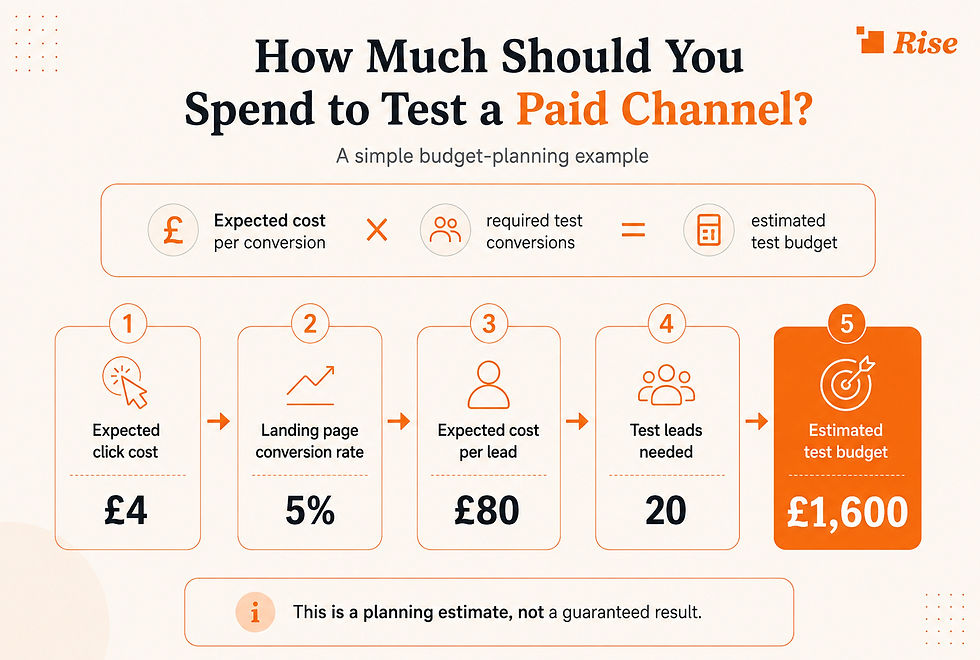
A simple starting formula is:
Test budget = expected cost per conversion × target number of test conversions
For example:
The expected click cost is £4.
The landing page converts 5% of visitors.
The expected cost per lead is therefore approximately £80.
The business wants 20 leads before making an initial assessment.
The estimated test budget would be:
£80 × 20 = £1,600
This does not guarantee that 20 leads will provide a definitive answer.
It simply creates a more rational budget than selecting an arbitrary daily amount without considering the likely cost of acquiring enough data.
For businesses with long sales cycles, it may be necessary to evaluate earlier indicators such as qualified-lead rate, booked meetings and pipeline value before sufficient sales have occurred.
Why the advertising platform is only part of the answer
Paid-media results are influenced by far more than the channel selected.
A campaign may underperform because of:
A weak proposition
Poor audience understanding
Uncompetitive pricing
Ineffective creative
Inaccurate tracking
A slow or confusing website
A weak landing page
Poor mobile usability
An unnecessarily long form
Slow lead follow-up
A disconnected sales process
Insufficient customer trust
Optimisation towards the wrong conversion event
Changing advertising platforms will not solve these underlying problems.
Paid media should be treated as a complete system:
Strategy → audience → channel → creative → landing page → tracking → CRM → sales → revenue
Understanding the difference between your measurement structure and what customers actually experience is also important. Our guide to the marketing funnel and customer journey explains how to use both perspectives together.
Rise’s approach to PPC and paid-media management covers this wider system rather than treating campaign management as an isolated task.
This includes channel selection, forecasting, account auditing, creative, landing pages, tracking and the journey after the advertising click.
Improving the percentage of visitors who convert can also produce more revenue without increasing advertising spend.
That is why conversion-rate optimisation should be considered alongside media buying.

The most important paid-media trends in 2026
1. Advertising is moving into AI-led discovery
Advertising is no longer confined to search-result pages, websites and social-media feeds.
Google, Microsoft and OpenAI are developing advertising experiences within AI-powered search and conversational journeys.
This creates new opportunities.
It also creates questions around measurement, relevance, user trust and the role of advertising during complex research.
Businesses looking at AI more broadly should consider how it can support customer acquisition, content, CRM and marketing operations as part of an integrated AI marketing strategy.
2. Automation is becoming the default
Performance Max, AI Max, Advantage+, Smart+ and other automated campaign types are becoming central to advertising-platform development.
The advertiser’s role is shifting away from manually controlling every bid and audience.
Instead, advertisers need to give the systems better inputs.
These include:
Accurate data
Commercially meaningful goals
High-quality creative
Product information
Audience signals
Brand guidelines
Appropriate exclusions
Customer-value feedback
Automation magnifies the quality of the information it receives.
It does not compensate for poor strategy or bad data.
3. Creative is increasingly determining performance
As advertising platforms automate targeting and placements, creative differentiation becomes more important.
Businesses need a repeatable process for developing, testing and replacing advertising concepts.
Producing several minor variations of the same advertisement is unlikely to provide enough meaningful learning.
4. Advertisers are moving from leads to qualified outcomes
Optimising towards every form submission encourages platforms to find people who submit forms.
It does not necessarily find people who become good customers.
CRM integration allows businesses to feed information about qualified leads, opportunities, sales and customer value back into advertising platforms.
5. Search behaviour is fragmenting
Customers may now search through:
Google
Bing
Copilot
ChatGPT
TikTok
Reddit
Amazon
YouTube
Specialist marketplaces
Paid-search strategy therefore needs to consider where the audience investigates a problem.
It is no longer enough to look only at which traditional search engine has the largest overall market share.
6. Measurement remains imperfect
The complete disappearance of third-party cookies from Chrome did not happen in the way the advertising industry once anticipated.
However, measurement is still becoming more fragmented because of browser restrictions, consent requirements, mobile privacy changes, cross-device behaviour and the growth of closed platforms.
Businesses therefore need to combine:
Advertising-platform reporting
Web analytics
CRM data
Server-side or API-based integrations
Customer data
Attribution modelling
Incrementality testing
Commercial judgement
No individual dashboard provides a perfect version of reality.
How many paid advertising channels should a business use?
Businesses should use as many channels as they can fund, manage and measure properly—but no more.
Launching on six channels with insufficient budget, weak creative and limited management time is usually less effective than running one or two channels properly.
A sensible sequence is:
Identify where the strongest existing demand can be captured.
Establish reliable tracking and commercial targets.
Prove that the website and sales process can convert traffic.
Improve the strongest initial channel.
Add a second channel with a clearly defined role.
Measure whether the second channel creates genuinely incremental growth.
Expand only when the evidence supports it.
The objective is not to be present everywhere.
It is to build a paid-media mix in which each channel has a clear and measurable purpose.
For a wider view of how paid media fits into a complete acquisition, conversion and retention strategy, read our guide to growth marketing tactics and channels.
So, which is the best paid advertising channel in 2026?
For most businesses, the answer can be summarised as follows:
Choose Google Search when customers already know what they need and actively search for it.
Choose Meta when visual creative can generate interest among a broad consumer audience.
Choose Microsoft when you want additional search reach, particularly among professional and B2B audiences.
Choose LinkedIn when reaching the right company, role or decision-maker justifies a higher media cost.
Choose TikTok when the product suits native short-form content and discovery-led buying.
Choose YouTube when education, demonstration and trust are important parts of the decision.
Choose Amazon or retail media when customers are already shopping within those platforms.
Choose Reddit when specialist communities influence the purchase.
Test ChatGPT Ads where customers undertake research and comparison, but treat it as an emerging channel.
Consider programmatic and connected TV when the available budget, audience scale and measurement approach justify the complexity.
The strongest channel is not the one with the newest technology, the largest audience or the cheapest clicks.
It is the channel that brings the right potential customers into a journey that converts them profitably.
Need help deciding where to invest?
Choosing a paid advertising channel should begin with your business.
It should not begin with the platform that an agency or freelancer happens to specialise in.
At Rise, we look at your audience, margins, customer journey, existing data, available creative and realistic budget before recommending where you should spend.
Our collective model gives you direct access to senior, UK-based specialists selected according to the channels your business actually needs.
You will have complete transparency around:
Who is working on your account
What they are doing
How much time they are spending
What your budget is achieving
Where a channel is unlikely to work for your business, we will tell you.
Where the bigger opportunity lies in your landing page, tracking, proposition or follow-up process rather than increasing ad spend, we will tell you that too.
Rise can support you with:
Paid-media channel selection
Account and tracking audits
Strategy, planning and forecasting
Google, Meta and Microsoft Ads
TikTok, LinkedIn and Amazon Ads
Apple Search Ads and app acquisition
Programmatic and paid-social campaigns
Creative strategy and production
Landing pages and conversion optimisation
Full-funnel measurement
Explore Rise’s PPC and paid-media support, or book a call with a growth marketing specialist to discuss what you are trying to achieve.
Frequently asked questions
What is the best paid advertising channel in 2026?
There is no universally best platform.
Google Search is generally strongest for capturing existing demand.
Meta and TikTok are effective for creating consumer demand, LinkedIn provides precise B2B targeting and Amazon reaches shoppers close to purchase.
The right choice depends on your audience, objective, budget and commercial model.
Is Google Ads or Meta Ads better?
Google Ads is generally better for reaching people who are already searching for a product or service.
Meta Ads is generally better for creating demand through visual advertising.
Many businesses eventually use both, but smaller businesses should begin with the platform most closely aligned with how their customers buy.
Which paid advertising channel is best for B2B?
Google Search, Microsoft Advertising and LinkedIn are usually the most relevant B2B advertising channels.
Google and Microsoft capture existing demand, while LinkedIn can target specific industries, companies and professional roles.
The best option depends on customer value, sales-cycle length and how narrowly the audience needs to be defined.
Which advertising platform is best for ecommerce?
Google Shopping, Performance Max, Meta and Amazon are among the most important ecommerce channels.
TikTok and Pinterest may also perform strongly for visually demonstrable products.
The right mix depends on margins, average order value, repeat-purchase behaviour and creative resources.
Is Microsoft Advertising worth using?
Microsoft Advertising can be worth using for businesses that already generate results from paid search and want additional reach.
It can be particularly relevant for B2B and professional audiences.
Its integration with Copilot also makes it increasingly important within AI-led search.
Are TikTok Search Ads worth testing?
TikTok Search Ads are worth considering when the target audience uses TikTok to research relevant products, services or topics.
They combine keyword targeting with TikTok-native creative.
However, the available search volume and commercial value will vary considerably by category.
Can businesses advertise in ChatGPT?
Yes.
OpenAI has introduced advertising in ChatGPT alongside an Ads Manager, cost-per-click bidding and campaign measurement.
The platform is still developing, so advertisers should evaluate it through controlled tests rather than assuming it will immediately outperform established channels.
How much should a business spend testing paid advertising?
The test budget should be based on the expected cost per conversion and the number of conversions needed to make a reasonable initial assessment.
A useful formula is:
Expected cost per conversion × required test conversions = estimated test budget
How long does paid advertising take to work?
Search campaigns can begin producing traffic and conversions quickly where demand already exists.
Demand-generation channels may take longer because the business needs to test audiences, messaging and creative.
Longer sales cycles also mean revenue may not become visible until weeks or months after the initial advertising interaction.
How many paid channels should a business use?
A business should use only as many platforms as it can fund, manage and measure properly.
For many startups and SMEs, proving one primary channel and then adding a second complementary channel is more effective than spreading a limited budget across several platforms.
Can Rise help us choose and manage the right paid channels?
Yes.
Rise can assess your audience, economics, current campaigns, tracking, creative and customer journey before recommending which paid channels to prioritise.
Our senior specialists can then audit, launch and manage campaigns while working directly and transparently with your team.
Find out more about Rise’s paid-media services, send us a message or book a call with a growth marketing specialist.